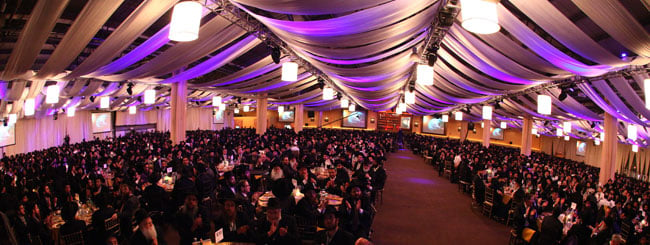

Thousands of Chabad-Lubavitch rabbis from more than 100 countries and every U.S. state began converging on Brooklyn, N.Y., today for the 43rd International Conference of Chabad-Lubavitch Emissaries. The annual gathering, known as the Kinus Hashluchim, runs through Monday and brings together the leaders of a global network of more than 6,000 emissary couples and the communities they serve.
Over five days, the rabbis will attend workshops and programs and meet with colleagues they may not see the rest of the year. Together, they will set the direction for the year ahead. On Friday, the emissaries will visit the Ohel in Queens, the resting place of the Rebbe, Rabbi Menachem M. Schneerson, of righteous memory, to pray for their families, communities and respective countries. They will spend Shabbat together in Crown Heights, and on Sunday morning gather for the famous “class reunion” photo before the conference closes with its gala banquet that evening.
“The Kinus is the place where 6,500 leaders, real leaders for life, come together,” said Rabbi Levi Greenberg, program director at Chabad-Lubavitch of El Paso, Texas. “It represents the convergence of rabbis from around the world, leading communities, getting ready to learn from each other. The real change that impacts Jewish communities of the world often starts here.”

Where Ideas Take Root
For many emissaries, the most significant part of the Kinus is what they bring home. The Rebbe encouraged emissaries to leave the conference with hachlatot, practical resolutions, and many of Chabad’s best-known programs began that way.
“The Kinus is a breeding ground for ideas and institutions, for things to grow within Chabad and thereby the entire Jewish world,” Greenberg said. “You take ideas from colleagues and showcases, and they evolve and impact your own work within your community.”
The mission itself is fixed, Greenberg stressed.
“From the beginning of his leadership, the Rebbe clearly articulated our mission to prepare the world for Moshiach and clarified the principles of how to get this done, to saturate the world with goodness. That’s set,” he said. “But over time, more and more people come up with ways of communicating the message, and these ideas can work in more than just one place. The Kinus is this marketplace of ideas.”
He recalled meeting a man who works at the United Nations. “He told me, ‘I work for the U.N., so theoretically you’d think I’d have access to this massive network around the world. But what you have is incomparable.’ The trust, the huge network you hear about is not just a directory. It’s real. These are people who are connected through thick and thin.”

What the Numbers Show
The emissaries arrive as new research confirms that the post-Oct. 7 “surge” in Jewish engagement is holding, and that Chabad is where many of these newly-engaged Jews are going. A Jewish Federations of North America (JFNA) survey released last month found that this “surge” grew to 38% of American Jews this year, up seven points from 2025. Among communally engaged Jews in the surge, the plurality turned to Chabad.
JFNA’s 2025 survey had already found the largest rise among Jews connected to Chabad, with 44% reporting deeper engagement since Oct. 7, 2023. “Close to half of those people who are part of this ‘Surge,’ this group showing up more in some way, are doing it through Chabad,” Kravetz told Chabad.org last year.
Those Jews come from across the spectrum. Half of Chabad participants are unaffiliated, and 39% identify as Reform, 20% as Conservative, 21% as Orthodox and 15% with no denomination.
“They’re identifying with whatever denomination they think of themselves as, and then saying, but I go to Chabad,” Kravetz said last year. Among Jews ages 18 to 34, Chabad ranked as the most popular way to engage, second only to “spending time with Jewish friends.”

A Seat at the Table
That last finding is no surprise to Rabbi Dovid Goldshmidt, who directs CTeen of Atlanta with his wife, Talya. A former CTeen member himself—CTeen being Chabad’s teen network—he became the first alumnus of the program to return as a CTeen rabbi. The couple founded the Atlanta chapter in 2022 and now run a bar and bat mitzvah club, leadership and mentorship programs, and Shabbat dinners a couple of times a month for middle and high schoolers.
“Our goal is to reach out to every Jewish child in Atlanta,” said Rabbi Goldshmidt. “We’re invested. This is our commitment.”
He says the reason for their success is simple.
“Kids are really connected with authenticity. They don’t fool themselves, and they don’t buy it from others,” he said. “They want authentic Judaism, and we make sure they see and feel that. We sit together, learn and share together, and they just feel it in their souls. It’s a real family environment.”
The setting matters too. “They see a lot of social pressure at school,” he said. “But here, they may see 30 other Jewish kids from eight other schools, and it breaks a lot of walls.”

Recently, the Goldshmidts met an Israeli family new to Atlanta, whose daughter is in 11th grade. She began coming to programs and Shabbat meals. “Her mom told us that in the 10 months they’ve been here, she’s been saying how hard it’s been leaving Israel,” said Goldshmidt. “And now she found CTeen, and she finally feels like she belongs.”
For Goldshmidt, this week is a chance to step back from that work and return to its source.
“It reminds us why we do what we do,” he said. “It’s our calling, but it’s certainly not easy, and it’s possible to lose sight of why we’re doing this. The Kinus is the opportunity to reorient ourselves to the Rebbe’s mission, to connect with our friends and colleagues, many whom I’d never get to see, and to learn from them to apply it to our own work.”
Greenberg sees Friday’s visit to the Ohel as the highlight of the week.
“It’s not just about shluchim coming to see and learn from each other. We come to connect to the Rebbe who sent us to do our work,” he said. “We come to recommit to the mandate the Rebbe gave us, and we go home inspired and enriched.”