

Pull up at any time, day or night, and you’ll know you’re there. You’ll know it by the lights, by the soft hum of generators, by the quiet, orderly comings and goings of men and women of all ages. Most of all you’ll know it by the sense of calm that fills this holy place, touching all who venture to “the Ohel” on Francis Lewis Boulevard in Queens, N.Y.
The site is the burial place of the Rebbe, Rabbi Menachem M. Schneerson, of righteous memory, the most influential rabbi in modern history. Millions of people send their written prayers to the Ohel via email and post, while some 1 million make pilgrimages there each year. They are religious and not, laypeople and leaders, Jews and non-Jews, each one coming to pray, seek inspiration and find solace.
An average day at the Ohel—located just 10 minutes from JFK Airport—might see visits from foreign heads of states, cultural figures and thought leaders from diverse backgrounds, all of whom come in private capacities with little fanfare, seeking not cameras but to draw strength for the formidable responsibilities each of them face. They join regular men, women and children who come to pray at the Rebbe’s resting place, asking that he intercede on their behalf before G‑d for health for themselves or their loved ones, blessing to find a lifemate, the wisdom to parent, success in their professional lives or any number of other requests buried deep within the human heart.
It is common for people to visit the Ohel to pray in proximity to a personal or professional milestone, whether a bar or bat Mitzvah, wedding, anniversary, starting a new business or overcoming personal challenges. Sen. Cory Booker of New Jersey has made it a personal tradition to visit the Rebbe’s Ohel on the eve of his elections, as did Ivanka Trump prior to both of her father’s election days.
In November 2023, nearly 200 family members of hostages held by terrorists in Gaza made the trek to the Ohel for the express purpose of praying there. Months later, on the eve of Prime Minister Benjamin Netanyahu’s speech at the United Nations, his wife Sara joined another group of families of hostages at the Ohel.

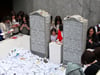
The Ohel is the most visited Jewish holy site in North America, drawing people from all walks of life in a way similar only to the Western Wall in Israel. But for all its prominence, the visitor center adjoining the Ohel is a simple place, comfortable yet sparse, open to all and at all hours. The resting place itself is even simpler: A brightly-lit open-air mausoleum made of granite, where people pray quietly and can leave their notes of supplication.
Visiting the resting place of the righteous is a long-held tradition in Judaism. The Talmud recounts how Caleb visited Hebron to pray at the Maarat Hamachpela (Cave of the Patriarchs), the resting place of the Biblical patriarchs and matriarchs. Resting places of Jewish mystics and sages in Israel and Europe are considered sacred spaces and have been visited by Jews and non-Jews for centuries.
In many ways the Ohel’s ascetic simplicity brings to mind the Rebbe’s study at 770 Eastern Parkway in Brooklyn, to which for decades a similarly diverse pool of visitors would come for the Rebbe’s wisdom and guidance.
Born in 1902 in what is today Ukraine, the Rebbe arrived in the United States after escaping from Nazi-occupied Europe, where he assumed leadership of the worldwide Chabad-Lubavitch Chassidic movement a decade later. The year was 1950, the dawn of a new age. European Jewry had been decimated in the Holocaust, Israel was just finding its footing, and American Jews struggled with what came next: Was there a place for Jewish life in the atomic age?
The Rebbe answered yes, emphatically. Whether in writing or in person, he counseled the men and women who sought his guidance that their Jewish heritage was intensely important, both to them and the world around them, these two elements intrinsically bound up with each other. Exuding positivity and hope, the Rebbe set about building schools, Jewish community centers and social service networks around the world, in the process engineering a global Jewish renaissance in the aftermath of the Holocaust.
But the Rebbe did not shepherd the Jewish community alone, instead emphasizing a universal vision for a better world. He spoke of the goodness inherent within all of humankind and the infinite potential of every individual and each good deed. He believed in the fundamental need to nurture this good within man via a moral and ethical education, especially among children, who must be impressed upon from the youngest age that it is within their capacity to change the world for the better.
In recognition of the Rebbe’s work, both in the public eye and behind the scenes, beginning in 1978 every U.S. president since Jimmy Carter has proclaimed Education and Sharing Day, U.S.A., on the Rebbe’s birthday. In 1994 he was posthumously awarded the Congressional Gold Medal in recognition of his “extraordinary life and work.”
Among those who made the trek to the Rebbe’s modest, book-lined study were Israeli leaders from Menachem Begin to Yitzchak Rabin, Shimon Peres to Benjamin Netanyahu, and cultural figures such as Bob Dylan, Herman Wouk and Jacques Lipchitz. But it was not only Jews who sought him out. Robert F. Kennedy and Sen. Henry “Scoop” Jackson visited the Rebbe. So did New York City Mayor John Lindsay, Sen. Daniel Patrick Moynihan, Rep. Shirley Chisholm and President Luis Alberto Lacalle de Herrera of Uruguay, each one receiving, as did the countless “nameless” individuals, his love and attention.

After the Rebbe’s passing in the summer of 1994, he was buried near his father-in-law and predecessor the Sixth Rebbe, Rabbi Yosef Yitzchak Schneersohn, of righteous memory, at Old Montefiore Cemetery in Queens. For nearly half a century, the Rebbe rarely left Brooklyn, for the most part traveling only to his father-in-law’s resting place, bringing with him the written supplications given to him and reading them out one by one at the holy site.
Today, amid the dizzying rush of modern life, the Ohel stands as an oasis of spiritual calm and connection, open to all who seek it out.



Start a Discussion